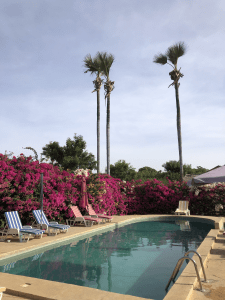
Friday, July 8th began with our group waking up in different accommodations than our usual residence in the Point E neighborhood of Dakar. We were woken up by the calls of goats and donkeys in a scenic rural lodge, where each of us stayed in a cabin. It would be the beginning of a unique day exploring Senegal outside of the major urban areas.
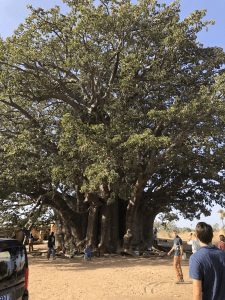
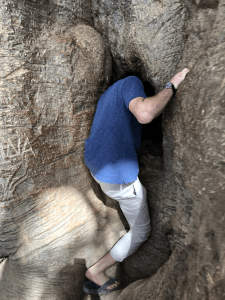
Our first activity of the day was exploring the biggest baobab tree in Senegal, conveniently located across the street from our lodging. The baobab tree possesses considerable practical and spiritual aspects in Senegalese culture. Its fruit, known as “monkey bread”, is notably healthy, its leaves can also be used to season food and the tree’s sap can be employed as glue. In addition, the baobab tree is viewed in an almost supernatural light by many Senegalese, largely because of its lifespan, some living up to 2,000 years. A long-standing practice outlawed in 1960 saw griots, powerful oral historians within West African society, being buried inside the baobab trees to preserve their spirit and knowledge. A cool opportunity presented itself when we were allowed to climb inside the enormous tree, which can fit over 30 people in its trunk. Although there were dozens of bats, it was still fun to be inside of one of the oldest, largest living things in Senegal!
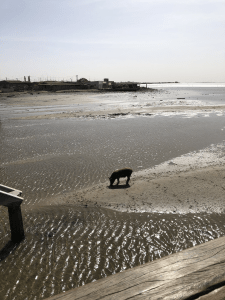
Next, we boarded a bus to visit the coastal towns of Joel and Fadiouth. Fadiouth was a classic example of the strength of community within Senegal. As we were walking around the town, our tour guide informed us that the community has no need for a police force. They simply gather in a designated meeting place to hash out issues, with the elders leading the discussion. Furthermore, at a church we visited, our group learned that the Muslims and Christians are so connected that when the church was damaged in a storm, both groups came together to repair it. Litter is a prominent feature in many of the communities we visited in Senegal due to a lack of infrastructure to collect trash. Fadiouth doesn’t have this problem however because the young people and tour guides organize the community to properly dispose of their garbage. After our tour of the town, we visited a cemetery on a hill where both Muslims and Christians are buried together, free of charge.
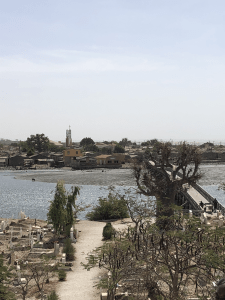
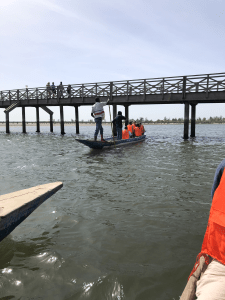
It was powerful to see just how close-knit the town is and it serves as an example which many communities should aspire to. We rode upon a pirogu boat to the restaurant where we ate lunch, soaking up some much-needed Vitamin D in the process.
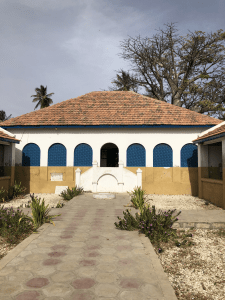
After a quick beach stop, the last part of our day was a visit to Senegal’s first president, Leopold Senghor’s, childhood home in Joal. Among other things, we learned that Senghor was one of 41 children, as his father had 5 wives. He was also the first African to become a professor at a French university. These experiences helped shape him to become the leader who was able to lead a former colony to independence and stability, building relationships with various ethnic and religious groups along the way. The tour certainly gave our group things to reflect on, especially why Senegal’s community is the way it is, for the couple-hour ride back to Dakar.
—Mike D
 Senegal: Culture and Service
Visiting Fadiouth was something that was definitely interesting to me because we learned in class all about how Muslims and Christians lived together without any real problems and after being in Fadiouth this fact was very evident. Especially, considering the fact that they have a cemetery for both Christians and Muslims.
-Maggie Fennelly
LikeLike